

A Step-by-Step AI Policy for Schools Framework for K–12 Leaders
The Problem: AI Is Already in Your Schools
Students are using ChatGPT to write essays and complete homework. Teachers are experimenting with AI grading tools. Administrators are fielding questions from parents, board members, and staff—and most don’t have clear answers yet. First, the reality is that artificial intelligence is already inside your district, whether you’ve approved it or not with an AI policy for your schools.
“AI capability is not plateauing. It is accelerating and reaching more people than ever… Over 80% of U.S. high school and college students now use AI for school-related tasks, but only half of middle and high schools have AI policies in place, and just 6% of teachers say those policies are clear.” The 2026 AI Index Report, HAI Stanford University
District AI Planning: Responsible AI Policies for Schools
Many forward-thinking districts have already begun putting AI policies in place. But if you’re leading a small or mid-sized district, you may not have a dedicated technology strategist or curriculum specialist with deep AI expertise on staff—and that’s okay. What matters is that you start now, before the gap between districts with clear AI guardrails and those without becomes harder to close.
Next, you might be thinking, “Yes, but without expertise, how do I create an AI policy for my school district?”
The good news is you don’t need a large team or a six-figure consultant to get this right. You do need a clear, written policy that gives your staff and students guardrails—and gives your community confidence that you’re leading thoughtfully. Your policy should be considered a “living document” that will remain flexible enough to adapt to rapidly evolving AI technologies.
The framework provided in this article and the ‘AI Policy for Schools Template‘ can help you get started.

Student Using AI on Laptop in Classroom
“Over 80 percent of students reported that teachers did not explicitly teach them how to use AI for schoolwork.” AI Use in Schools Rand Research, Sept 2025
What is an AI policy for schools?
An AI policy for schools is a formal district document that establishes guidelines for the responsible use of artificial intelligence by students, teachers, and staff. It typically covers acceptable use, student data privacy, academic integrity, and how AI tools are vetted and approved for classroom use. It establishes expectations and boundaries and sets best practices and parameters to protect students, staff, and the community.
What Happens When Districts Don’t Have an AI Policy for Schools?
Without a formal AI policy for schools, districts are exposed to a tangle of risks: student data privacy violations, inconsistent academic integrity standards, liability from unvetted tools, and missed opportunities to connect AI to broader strategic goals like your STEM initiative..
Let’s be direct about the stakes. When there is no AI policy for schools, districts face:
- Privacy exposure. Teachers and students may enter sensitive data into AI tools that store, share, or train on that information—violating FERPA and state privacy laws.
- Inconsistent expectations. One teacher bans AI completely while the teacher next door assigns AI-assisted projects. Students and parents are confused, and your district looks disorganized.
- Academic integrity chaos. Without shared definitions of acceptable AI use, plagiarism cases become subjective and difficult to enforce.
- Missed opportunities. AI can genuinely improve differentiation, feedback loops, and administrative efficiency—but only if educators know what’s approved and how to use it responsibly.
The longer your district waits, the wider these gaps become. A clear AI policy for schools doesn’t slow innovation down—it makes innovation possible.
You don’t have to start from scratch. We’ve built a free, editable AI Policy Template designed specifically for K–12 school districts
Where should we send this resource?

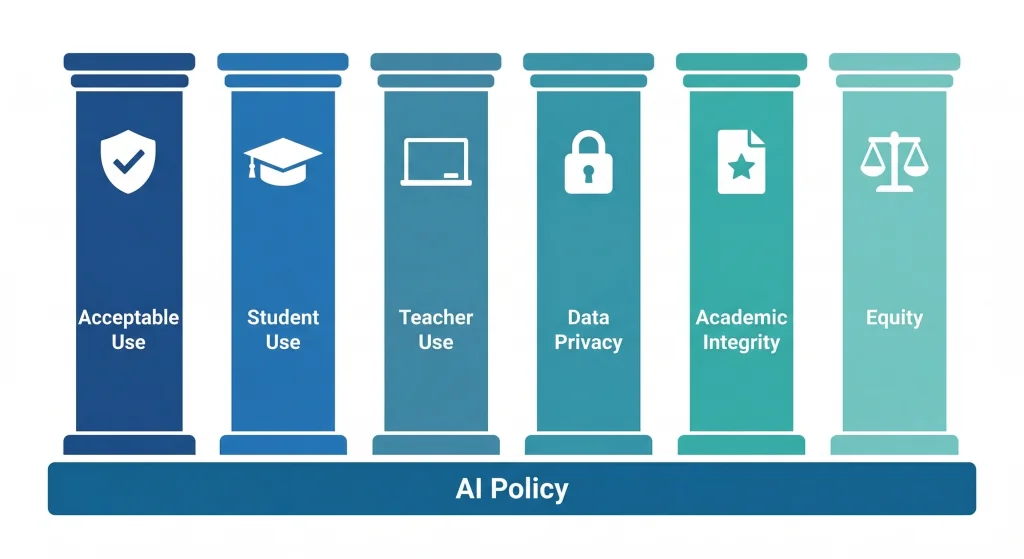
Six Pillars of an AI Policy for Schools
“To start, we need leaders at all levels — but especially at the state level where policy is usually made — to offer districts clearer support and guidelines about appropriate and inappropriate uses of AI in schools.” Morgan Polikoff, EdSource April 19, 2026
A Framework for Writing Your District’s AI Policy
You don’t need a 50-page legal document. You need a practical, readable policy that covers six essential areas. Here is the framework we recommend for any district writing an AI policy for schools.
1. Acceptable AI Use: Define the Boundaries
Start with the big picture. Your acceptable use section answers the question: “What AI tools are allowed, and under what conditions?”
This section should:
- Establish a vetting and approval process for new AI tools before they enter classrooms or offices.
- Maintain a list of approved AI tools (and explicitly banned ones).
- Require that any AI tool handling student data meets your district’s data privacy standards.
- Clarify who has the authority to approve or block AI tools (IT, curriculum, building admin, etc.).
- Create a formal tool request process with a defined timeline—for example, allowing staff to submit new AI tools for review with a 30-day window for vetting and approval.
Pro tip: Avoid blanket bans of tools. They push AI use underground and eliminate your ability to guide it. Instead, create a tiered approval system such as: green – approved tools, yellow – tools under review, and red – tools that are off-limits for now.
2. Student AI Use Policy: Set Age-Appropriate Expectations
Students across every grade level are already encountering AI. Your policy needs to meet them where they are.
Consider addressing:
- Elementary: Students should not directly interact with generative AI tools. Teacher-led demonstrations may be appropriate for digital literacy.
- Middle school: Supervised, structured use for specific assignments with clear guidelines on what AI assistance is and isn’t allowed.
- High school: More autonomy, paired with explicit instruction on ethical AI use, citation expectations, and critical evaluation of AI-generated content.
Pro tip: Whatever grade band you’re addressing, make the expectations concrete. “Use AI responsibly” is not a policy—it’s a bumper sticker. Spell out what responsible use looks like in practice.
Want some concrete examples of how to teach AI at each grade level to share with your teachers? See this article: Teaching AI in K-12: A Guide to AI Standards for Teachers.
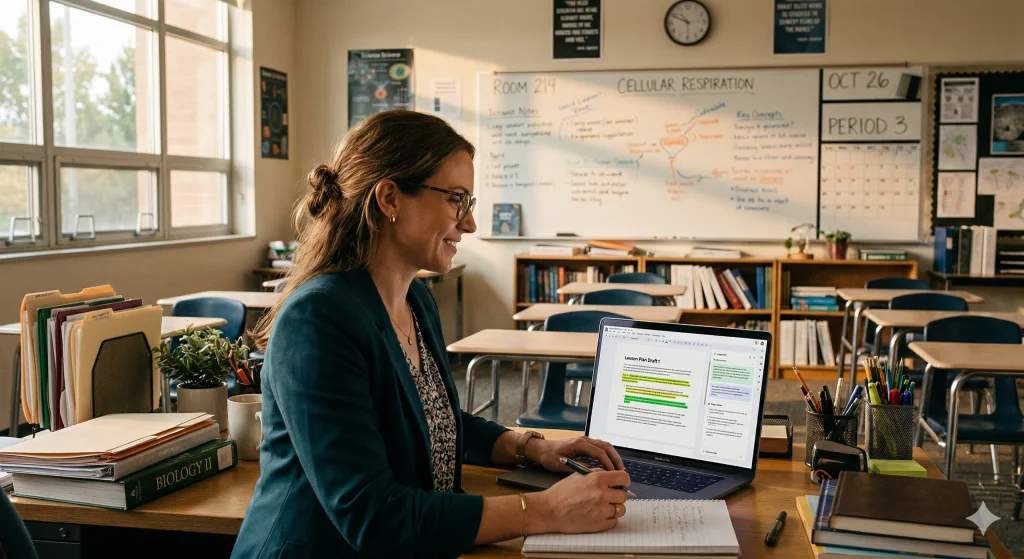
Teacher Using AI for Lesson Planning
“Only Forty-five percent of principals reported having school or district policies or guidance on the use of AI in schools, and 34 percent of teachers reported having school or district policies on the use of AI related to academic integrity.” AI Use in Schools Rand Research, Sept 2025
3. Teacher and Staff Use: Empower, Don’t Restrict AI Tools for Teachers
Your teachers are professionals. A strong AI policy for schools equips them to use AI as a tool—not a threat. The teaching staff are the primary translators of any new tool into daily practice across classrooms.
Your teacher-use section should:
- Clarify which tasks AI may be used for: lesson planning, differentiation, feedback drafting, data analysis, administrative tasks, etc.
- Set expectations around human review—AI-generated student feedback, grades, or communications should always be reviewed by a human before delivery.
- Require professional development so staff understand both the potential and limitations of AI tools.
- Prohibit entering identifiable student information into non-approved AI platforms.
Pro tip: The goal is a culture of informed experimentation, not fear. When teachers feel supported, they’ll innovate within your guardrails instead of around them.
Find out where your teachers are in their growth path of AI implementation. Provide teachers with professional development to understand AI tools, enabling them to lead discussions on AI’s impact and use AI for lesson planning or task automation.

Student Data Protection Concept
“Systems must comply with federal privacy laws including the Family Educational Rights and Privacy Act.” — U.S. Department of Education, “Guidance on the Use of Federal Grant Funds to Improve Education Outcomes Using Artificial Intelligence,” Dear Colleague Letter, July 22, 2025
4. Protect Your Students: AI Student Data Privacy and Security
This is non-negotiable. Your AI policy must address data privacy head-on, because AI tools are hungry for data—and some of that data belongs to minors.
Key elements to include:
- All AI tools must comply with FERPA, COPPA (for students under 13), and applicable state privacy laws.
- No student personally identifiable information (PII) may be entered into AI tools unless the vendor has a signed data privacy agreement on file.
- AI vendors must disclose how data is stored, used, and whether it’s used to train models.
- Establish a clear incident response plan for AI-related data breaches.
Pro Tip: Privacy isn’t just a legal obligation. It’s a trust issue. Parents and communities need to know their children’s data is safe.
5. AI Academic Integrity in Schools: Draw a Clear Line
This is the area where districts struggle most—and where a clear AI policy for schools makes the biggest immediate difference. Create a pedagogy-first approach: Focus on educational goals, not just the technology. AI should be treated as a tool to improve learning, similar to a calculator, not as a replacement for human thought.
Your academic integrity section should:
- Define what constitutes authorized vs. unauthorized AI use for student work.
- Require teachers to state AI expectations on every assignment (e.g., “No AI assistance,” “AI may be used for brainstorming only,” or “AI-assisted work is permitted with proper citation”).
- Establish a consistent citation standard for AI-assisted work district-wide. A simple, universal format works best—something like: “AI Assistance Disclosure: [Tool Name] was used to [description of use]. The final work reflects my own analysis and conclusions.” Our free template includes this exact format, ready to adopt.
- Outline consequences for misuse that are fair, progressive, and educational—not purely punitive.
Pro Tip: Resist the urge to rely on AI-detection software as your enforcement mechanism. These tools produce frequent false positives and can harm students unfairly. Focus instead on clear expectations and process-based assessments that demonstrate learning. Project based learning and student presentations are great assessment tools.
6. AI Equity and Accessibility in Schools: Make AI Work for Every Student
This is the section many districts overlook—and it matters deeply. If AI tools are only available to some students, or if they introduce bias, your district has an equity problem on its hands.
Your equity and accessibility section should address:
- All AI tools used for instruction must meet ADA and WCAG accessibility standards.
- AI tools used for language support or accommodations must be consistent with student IEP and 504 plans.
- The district should monitor AI tool usage data to identify and address disparities in access or outcomes across student populations.
- AI tools may not be used in ways that perpetuate or amplify bias based on race, ethnicity, gender, disability, English language proficiency, or socioeconomic background.
Pro Tip: For small and mid-sized districts, this section signals to your board, parents, and community that your AI policy isn’t just about technology—it’s about serving all students fairly. Our free template includes ready-to-adopt equity language that covers all of these areas.
Download the Free AI Policy for Schools Template
You don’t have to start from scratch. We’ve built a free, editable AI Policy Template designed specifically for K–12 school districts.
Where should we send this resource?
Putting Your AI Policy For Schools Into Action
Writing the policy is step one. Getting it adopted and followed is where the real work begins. Here’s a practical rollout sequence:
- Assemble a task force. Include administrators, teachers, IT staff, a school counselor, a parent representative, and—if possible—a student voice. Diverse perspectives make stronger policy.
- Audit current use. Survey staff and students to understand which AI tools are already in use and how. You can’t write effective policy without knowing your starting point.
- Draft and review. Use a proven framework (like the one in this post) and get feedback from stakeholders before finalizing.
- Train your people. Schedule dedicated professional development sessions. A policy nobody understands is a policy nobody follows.
- Review and revise regularly. AI is moving fast. Commit to reviewing your policy at least twice per year and updating it as tools and best practices evolve

Students Working with AI in a STEM Classroom
“Integrating AI into education systems helps to prepare both young and adult learners to contribute to an AI-driven society.” — James L. Moore III, NSF Assistant Director for STEM Education, August 2025 U.S. National Science Foundation
Beyond Compliance: AI School Policy as Part of Your STEM Initiative
Here’s what many districts miss: an AI policy for schools isn’t just a compliance document. It’s the foundation for integrating AI into your broader STEM initiative.
Think about it. If your district is investing in STEM programming—robotics clubs, coding courses, data science electives, maker spaces—artificial intelligence is the thread that connects all of it. AI is how students will interact with science, technology, engineering, and math in the workforce. A thoughtful AI policy doesn’t just protect your district. It positions you to lead.
When your AI policy is aligned with your STEM strategy, you can:
- Introduce AI literacy as a core component of your STEM curriculum, not an afterthought.
- Give teachers a clear framework for using AI tools in project-based STEM learning.
- Apply for STEM-related grants with confidence, knowing your district has a responsible AI use plan in place.
- Prepare students for careers where AI competency is expected—not optional.
AI in STEM Classrooms
For small and mid-sized districts especially, connecting your AI policy to STEM is a smart way to maximize the resources you already have. You don’t need a separate AI initiative. You need to make AI a purposeful part of the STEM work you’re already doing.
The connection between AI and STEM isn’t just an EdForTech perspective — it’s a federal priority. In August 2025, the National Science Foundation announced new funding specifically designed to expand K–12 AI education and strengthen the STEM workforce pipeline. NSF Assistant Director for STEM Education, James L. Moore III, stated that “integrating AI into education systems is essential to preparing learners to contribute to an AI-driven society.” The NSF is now actively funding projects that bring age-appropriate AI literacy into K–12 classrooms, with a particular focus on translating research into STEM classroom practices.
— U.S. National Science Foundation, “NSF announces new funding opportunities to advance AI education and build the STEM workforce of the future,” August 28, 2025
Need Help Connecting AI to Your STEM Strategy?
We get it—writing policy is one thing, but figuring out how AI fits into your specific district’s STEM goals is another challenge entirely. If you’re a district leader who wants expert guidance on building an AI policy that aligns with your STEM initiative, our consulting team can help.
We work directly with small and mid-sized school districts to:
- Audit your current technology landscape and STEM programming
- Develop a customized AI policy tailored to your district’s size, budget, and goals
- Create an AI integration roadmap for your STEM curriculum
- Train your teachers and staff so they feel confident, not overwhelmed
➤ Schedule a free consultation to discuss how we can support your district.
Creating an AI policy is one of the first steps toward responsible adoption. Our template gives districts a strong starting point. Let us know if you’d like help adapting it to your school system.
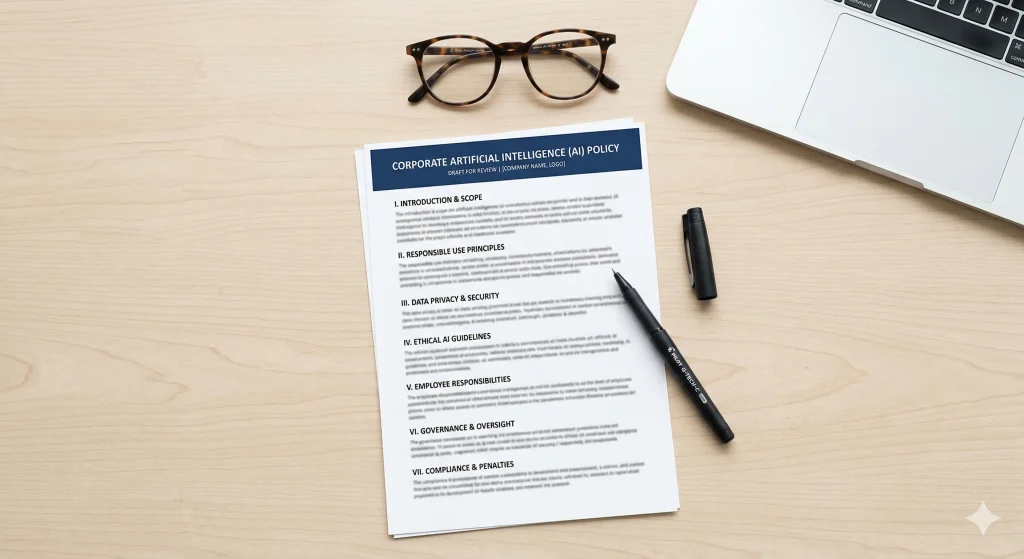
AI Policy Template Document Preview
Get Started Today: Download the Free AI Policy Template
You don’t have to start from scratch. We’ve built a free, editable AI Policy Template designed specifically for K–12 school districts. It covers every section outlined in this post—acceptable use, student use, teacher and staff use, data privacy, academic integrity, and equity—with fill-in-the-blank prompts so you can customize it to your district’s needs.
What’s inside the template:
- Pre-written policy language you can adopt or adapt
- Grade-band guidelines for student use
- A data privacy checklist for vetting AI vendors
- Sample academic integrity language and a district-standard AI citation format
- Equity and accessibility requirements
Free Download: AI Policy Template
Want a clear roadmap for implementing AI in your district?
Where should we send this resource?
Your district doesn’t need a perfect policy. It needs a written one. Download the template, bring your team together, and take the first step toward leading your community through the AI transition with clarity and confidence.
These steps help your school turn AI strategy into real classroom results.
About the Author
Linda Nichols-Plowman is the Founder & CEO of EdForTech (edfortech.com), an EdTech company dedicated to helping K–12 school districts navigate the rapidly evolving world of artificial intelligence. With a focus on small and mid-sized districts, EdForTech provides consulting services, policy frameworks, and professional development to help school leaders integrate AI into their STEM initiatives and district operations with confidence.
Linda is passionate about bridging the gap between emerging technology and practical classroom implementation — ensuring that every district, regardless of size or budget, has the tools and guidance to prepare students for an AI-driven future.
This article was written as a collaborative effort between Linda Nichols-Plowman and Claude Opus AI by Anthropic. The ideas, strategy, and editorial direction are the author’s own. Claude Opus served as a writing and research partner throughout the drafting process — a practical example of the kind of responsible, human-led AI collaboration that EdForTech helps districts build into their own workflows.
Where should we send this resource?
Share This Article
Artificial intelligence is already active in K-12 schools, but without clear guardrails, districts face significant risks from data privacy violations to academic integrity chaos. Don’t wait for the gap to widen. This article, “AI Policy for Schools: A Framework for K-12 Districts,” provides the step-by-step guidance you need to create a clear, written AI policy. It details the six essential areas every policy must cover, from setting age-appropriate student expectations to protecting PII under FERPA and COPPA. Get the practical framework for acceptable use, teacher empowerment, and academic integrity that also integrates AI literacy into your STEM goals. Bonus: Download the free, editable AI Policy Template to get your district started today..
FAQs: Common Questions About the AI Policy for Schools
Resources: Trusted Links for AI Policy for Schools
Building a strong AI policy for schools is easier when you know where to look for guidance. The following resources—from government agencies, research organizations, nonprofits, and education associations—provide frameworks, toolkits, data, and best practices that can support your district’s AI policy development.
- Government Sources
- U.S. Department of Education — AI Guidance for Schools: The Department’s official AI guidance page includes the July 2025 Dear Colleague Letter on using federal grant funds to support responsible AI integration, along with an inventory of federal AI use cases in education. Essential reading for any district navigating compliance and funding. https://www.ed.gov/about/ed-overview/artificial-intelligence-ai-guidance
- Education Commission of the States — AI Education Policy Tracker: A nonpartisan resource tracking AI-related education legislation and task forces across all 50 states. Useful for understanding how your state is approaching AI regulation and for benchmarking your district’s policy against emerging state requirements. https://www.ecs.org/artificial-intelligence-ai-education-task-forces/
- AI for Education — State AI Guidance Tracker : A comprehensive directory of AI guidance documents issued by state departments of education across the country, including links to the full guidance documents from states like California, Georgia, Vermont, Missouri, and more. https://www.aiforeducation.io/ai-resources/state-ai-guidance
- Research Organizations
- RAND Corporation — AI Use in Schools Reports: RAND’s American Educator Panel and American School District Panel produce some of the most cited research on AI adoption in K–12. Their reports track how many teachers and students are using AI, what training districts provide, and where policy gaps exist. Excellent data to cite when building your case to the school board. https://www.rand.org/pubs/research_reports/RRA4180-1.html
- Digital Promise — AI Literacy Framework: Digital Promise’s AI Literacy Framework gives districts a research-backed model for understanding, evaluating, and using AI. Their professional learning programs for district leaders and educators can help your team build capacity for AI integration. They also offer the Responsibly Designed AI product certification for evaluating edtech vendors. https://digitalpromise.org/initiative/artificial-intelligence-in-education/ai-literacy/
- Nonprofits & Education Associations
- TeachAI — AI Guidance for Schools Toolkit: A collaboration between Code.org, CoSN, Digital Promise, the European EdTech Alliance, and PACE. The toolkit provides seven principles for developing AI guidance, real-world policy examples, sample language, and downloadable resources for staff, parents, and students. One of the most comprehensive free resources available. https://www.teachai.org/toolkit
- ISTE+ASCD — AI in Education Resources: ISTE (International Society for Technology in Education) offers free guides for school leaders, including “Bringing AI to School: Tips for School Leaders,” hands-on AI classroom project guides, and the GenerationAI initiative. They are also the largest provider of AI professional development for educators. https://iste.org/ai
- AI4K12 Initiative — National AI Education Guidelines: A joint project of AAAI and CSTA, AI4K12 is developing U.S. national guidelines for what K–12 students should know about AI. Their “Five Big Ideas in AI” framework and grade-band progression charts are essential references for districts building AI literacy into their STEM curriculum. https://ai4k12.org
- CoSN (Consortium for School Networking) — AI in K–12 Education: CoSN offers resources specifically for district technology leaders, including their Generative AI Maturity Tool, the AI Advisor interactive tool for district leadership teams, and reports on the state of EdTech. Their partnership with ISTE on responsible use policy guides is particularly relevant for policy development. https://www.cosn.org/ai/
- aiEDU (The AI Education Project) — Free AI Literacy Curriculum: A nonprofit focused on equitable AI literacy for all students. aiEDU provides free curriculum resources, professional development for teachers, and the AI Readiness Framework—a practical roadmap for students, educators, school leaders, and districts. Particularly valuable for districts looking to integrate AI literacy across core subjects, not just computer science. https://www.aiedu.org
- CSTA (Computer Science Teachers Association) — AI Learning Priorities for K–12: CSTA partnered with AI4K12 to develop foundational AI learning outcomes organized by grade band. These priorities help districts understand what AI content belongs in the curriculum and at which grade level—a key reference when connecting your AI policy to STEM standards. https://csteachers.org/ai-priorities/
- Privacy & Legal Compliance
- Student Privacy Compass: A resource from the Future of Privacy Forum’s Education & Youth Privacy team. Student Privacy Compass provides state privacy law trackers, guides on student monitoring, and practical resources to help districts navigate FERPA, COPPA, and state-specific student data privacy requirements. https://studentprivacycompass.org
- TeachAI — Policy Resources & State Guidance Directory: A curated collection of AI policy guidance from U.S. states and countries worldwide, along with privacy resources from the U.S. Department of Education. Includes links to AI policy templates published by individual states like Alabama and Colorado, which can serve as useful models for your own district. https://www.teachai.org/policy-resources
(This article was generated as a collaborative effort between the human author, Linda Nichols-Plowman, CEO of EDforTech and the AI assistants, Chat GPT 5 and Claude Sonet).