
How district leaders can integrate AI into STEM learning, teacher workflows, and district strategy with an AI Implementation Guide for Schools.
School districts across the country are searching for a clear AI implementation guide for schools—one that builds confidence in AI tools and moves beyond theory and offers practical steps for responsible adoption. The pressure is real: teachers are experimenting with AI tools, students are already using them, and parents are asking questions.
Meanwhile, district leaders are asking the question that matters most: ‘What does responsible AI adoption actually look like in our schools?’
The challenge is not interest. The challenge is implementation. Many districts and schools face the same problems:
- No clear AI strategy
- Uncertainty about policy and data privacy
- Teachers unsure how to use AI in classrooms
- STEM programs that want to explore AI but lack guidance
- Too many tools and not enough direction
Why a Structured School District AI Adoption Plan Matters
Without a clear plan, AI adoption becomes scattered. Some teachers experiment. Some avoid it entirely. Students use it without guidance. District leaders know AI will shape the future of STEM careers and innovation, but translating that reality into classroom implementation is where many schools get stuck.
That’s why districts need a structured school AI strategy. This guide walks through a practical framework for AI adoption in schools, with a focus on strengthening:
- STEM learning and inquiry
- Teacher workflows and lesson design
- District operations and decision-making
- Career-ready skills for students
If your district is exploring AI in K-12 education, this article will help you move from uncertainty to a clear, actionable implementation plan.
Where should we send this resource?
The Real Problem: AI Is Entering K-12 Classrooms Without a Strategy
AI didn’t arrive in schools through a district rollout. It arrived through students. Students began using AI tools for homework help, coding support, research summaries, and project brainstorming. Teachers soon followed—some began using AI to generate lesson plans, create rubrics, and differentiate instruction.
But in most districts, this adoption is happening without guidance or training. That creates three major challenges.
- 1. Inconsistent Classroom Practices. One teacher embraces AI. Another bans it completely. Students receive mixed signals about what is allowed and how AI should be used responsibly.
- 2. Missed Opportunities for STEM Learning. AI could be used to support data analysis, engineering design, and scientific investigation. But without training, those opportunities are rarely realized.
- 3. Policy and Privacy Risks. District leaders worry about student data protection, academic integrity, and tool approval processes. Without a district strategy, these concerns slow progress rather than guide it.
The result? AI is present in schools—but not implemented effectively. That’s where a structured school AI strategy becomes essential.

Why AI Literacy Is Now Part of STEM Literacy
STEM education is about preparing students to solve complex real-world problems—and those problems increasingly involve data, automation, and artificial intelligence. According to the AI4K12 Initiative, AI literacy should include understanding how training data, algorithms, and ethical use shape the technology students interact with every day.
In modern STEM careers, professionals regularly use AI to analyze research data, design engineering solutions, model environmental systems, and accelerate scientific discovery. This means AI literacy is quickly becoming part of STEM literacy.
The International Society for Technology in Education (ISTE) emphasizes that effective AI integration in schools requires teachers to move beyond tool use toward teaching students how to think critically about AI systems and their societal implications.
School districts that thoughtfully implement AI can enhance project-based learning, expose students to real-world problem solving, and prepare students for future STEM careers. But doing this effectively requires intentional district planning and a theory of action—not just tool access.
What District Leaders Are Really Asking About AI Adoption
Most district leaders are not asking “Should we allow AI?” That decision has already been made by reality. Instead, they are asking:
- How do we guide principals and teachers in using AI responsibly?
- How can AI support STEM learning rather than replace thinking?
- What policies should we have in place?
- Where do we begin?
One solution for a structured AI implementation is EdforTech’s STEM AI Leadership Framework™. Let’s walk through it.
The STEM AI Leadership Framework™ for School Districts
Successful districts approach AI adoption in schools the same way they implement any major instructional initiative. They start with strategy, build infrastructure, create policies, train teachers, and then scale. Below is EdforTech’s practical leadership framework for introducing AI across STEM classrooms and district operations.
The U.S. Department of Education’s 2023 AI report recommends that districts center AI planning on educational equity and human agency—principles that run throughout this framework.
Stage 1: VISION – Align AI Strategy with STEM Goals
AI should support your district’s broader STEM vision. Start by asking: How should AI enhance STEM learning experiences? Which grade levels should introduce AI concepts? How can AI support project-based learning?
Many districts form an AI + STEM leadership team including:
- STEM coordinators
- Curriculum leaders
- Technology directors
- School administrators
- Teacher representatives
This group helps guide district AI planning and ensures that AI supports STEM initiatives such as robotics programs, engineering pathways, computer science courses, and career and technical education (CTE).
Key question: How can AI make learning more authentic and future-focused for our students?
Stage 2: FOUNDATION— Build the Infrastructure for AI and STEM Innovation
Hands-on STEM learning requires robust technology infrastructure, and AI implementation adds additional requirements. Districts should evaluate three areas:
- IData Security: AI tools interacting with student data must comply with FERPA, COPPA, and applicable state privacy laws.
- Platform Integration: AI tools should work smoothly with learning management systems, curriculum platforms, data visualization tools, and coding or robotics environments.
- Device and Network Readiness: STEM and AI integrated classrooms rely on student laptops or tablets, cloud-based applications, simulation software, and collaborative platforms. Reliable infrastructure ensures teachers can integrate AI without technical barriers
“The broadest loop teachers should be part of is the loop that determines what classroom tools do and which tools are available. Teachers can weigh in on tool usability and feasibility. Teachers examine evidence of efficacy and share their findings with other school leaders. Teachers already share insights on what is needed to implement technology well.” [2]
Stage 3: INTEGRITY— Develop Responsible AI Policies for Schools
AI policies are essential for maintaining trust and academic integrity. Districts should address three areas:
- Student Use: Policies should clarify when AI assistance is allowed and how it must be cited in student work.
- Academic Integrity: Assessments should distinguish between AI-assisted work and independent student reasoning.
- Data and Privacy: District-approved tools should meet strict privacy standards aligned with FERPA and state requirements.
Clear policies allow teachers to integrate AI into STEM learning without uncertainty.
Stage 4: CAPACITY— Train Teachers to Use AI in Instruction
Teachers are the most important factor in successful AI adoption. Professional development should focus on practical classroom integration, not just theory. Training should cover:
- AI Fundamentals for Educators: What AI is, how machine learning works at a basic level, and where AI is used in STEM fields.
- AI-Powered STEM Teaching Strategies: Generating project ideas for engineering challenges, creating differentiated STEM activities, analyzing student data during experiments, and developing inquiry-based learning prompts.
- AI Tools for Student Exploration: Guiding students in using AI for data analysis, coding support, research assistance, and design simulations.
When teachers see AI as a STEM learning accelerator, adoption increases dramatically. For a deeper look at this topic, see our article on Teaching AI in K-12.
Stage 5: LAUNCH— AI Pilot Programs
The best way to begin AI adoption is with small pilot programs. STEM classrooms are an ideal starting point because they already emphasize experimentation and innovation. Examples include:
- AI in Engineering Projects: Students use AI tools to generate design ideas and test solutions.
- AI for Scientific Data Analysis: Students analyze environmental or lab data using AI-powered tools.
- AI in Robotics and Computer Science: Students explore machine learning concepts through coding and robotics.
- AI-Assisted STEM Research Projects: Students investigate real-world problems using AI-supported analysis.
Pilot programs allow districts to gather teacher feedback, evaluate student engagement, identify training needs, and refine policies. Successful pilots can then expand across more schools and subjects.
Stage 6: SCALE— Expand, Monitor, and Improve
Launching a successful pilot is a milestone. But it is not the finish line.
This stage is where AI adoption becomes a permanent part of how your district operates — not a one-year initiative, but an ongoing program embedded in strategic planning, professional development, and annual budget cycles. Districts that treat Stage 6 as the beginning of a long-term commitment are the ones that see AI have a lasting impact on student outcomes.
The goal of Scale is not to rush AI into every classroom at once. It is to expand thoughtfully, monitor consistently, and improve continuously — using what you learned in your pilots to guide every decision going forward.
Key question: How do we grow what is working, sustain what we have built, and keep improving as the technology and our capacity evolve?
Expand Based on Evidence, Not Pressure
The best expansion decisions come from pilot data, not external pressure. Before scaling AI to additional schools or grade levels, your leadership team should be able to answer:
- Which pilot classrooms saw the strongest student engagement or outcomes?
- Which AI tools are teachers actually using — and which have been abandoned?
- What training gaps emerged that need to be addressed before expanding?
- Are there equity concerns — schools or student populations not yet benefiting from AI-enhanced learning?
Use those answers to build a phased expansion plan. Prioritize the schools, grade levels, or subject areas most likely to succeed based on infrastructure readiness, teacher capacity, and leadership support. A well-planned expansion grounded in evidence moves faster and encounters fewer setbacks than one driven by urgency alone.
Make AI Training Ongoing, Not One-Time
One of the most common scaling mistakes districts make is treating professional development as a Stage 3 activity that is finished when pilots begin. At Stage 6, AI training needs to expand and deepen alongside the program.
This means offering advanced PD tracks for teachers who are ready to move beyond the basics and lead others. It means providing building-level AI coaching for new schools coming into the program. It also means creating incentives — stipends, schedule accommodations, or recognition — for teachers who take on AI leadership roles in their buildings.
The Teacher AI RISE Map™ is a useful tool here. As you scale, principals and instructional coaches can use the four stages — Recognize, Integrate, Sustain, Elevate — to identify where each teacher is in their AI journey and target support accordingly. A teacher at the Recognize stage in a newly expanded school needs different support than one who is ready to Elevate into peer mentoring.
Establish an Annual AI Program Review
Scaling without monitoring is how programs drift. Districts that sustain AI programs over time build a formal annual review process that keeps leadership aligned and accountable.
A strong annual AI program review should assess:
Where should we send this resource?
- Tool effectiveness: Are the approved AI tools still the best options available? Are teachers using them? Are students benefiting?
- Training needs: Where are the remaining gaps in teacher AI literacy across the district?
- Policy updates: As AI tools evolve and new research emerges, do your policies reflect current best practices?
- Equity indicators: Are all student groups — including English language learners, students with disabilities, and students from underserved communities — benefiting equally from AI-enhanced learning? The ISTE AI in Education Framework identifies equitable AI access as a core principle, not an afterthought.
This review should be presented to the Board of Education annually, creating the same accountability structure that governs other district programs.
Transition AI from Grant Funding to the Operating Budget
Many districts launch AI initiatives with Title II-A, Title IV-A, or competitive grant funding — and that is a smart starting point. But grant funding has expiration dates, and the most common reason a well-designed AI program stalls at Stage 6 is that the budget that launched it disappears before the program is self-sustaining.
The goal of Stage 6 budgeting is to move AI from a funded initiative to a permanent line item in the district operating budget. This signals to teachers, families, and the Board that AI is not an experiment — it is part of how this district operates.
This transition should also include an annual AI budget review alongside the program review. Assess the return on your investment: which tools are being actively used, which have been underutilized, and where reallocation would have greater impact. Budget decisions at Stage 6 should be driven by outcome data, not habit or vendor loyalty.
Build a Culture of Responsible AI Innovation
Scale is not just about expanding tools and training. It is about building a school culture where responsible AI innovation is recognized, celebrated, and continuously renewed.
Practical ways to build that culture include:
- Celebrating teacher success stories publicly — in newsletters, at Board meetings, and at professional learning events — to normalize AI use and inspire peers
- Exploring partnerships with organizations such as AI4K12, ISTE, or regional education services like BOCES for ongoing professional learning resources and community
- Revisiting your district AI vision annually to ensure your strategic goals reflect both where your program has grown and where the technology is heading
Districts that reach Stage 6 have built something most are still working toward: a coherent, equity-centered, sustainable AI program rooted in STEM learning and teacher capacity. That is worth recognizing — and worth protecting through intentional leadership every year.
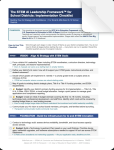
Free Download: AI Implementation Guide for Schools Checklist
Want a clear roadmap for implementing AI in your district?
Where should we send this resource?
Many districts know AI is important but struggle with where to begin. Our checklist walks district leaders through the key steps of AI adoption in schools: ✔ Strategic planning for AI in STEM programs ✔ Infrastructure and technology readiness ✔ Teacher training and professional learning ✔ Responsible AI policy development ✔ Pilot rollout planning
These steps help your school turn AI strategy into real classroom results.
What Is an AI Implementation Strategy for Schools?
A school AI implementation strategy is a structured plan that helps district leaders introduce artificial intelligence into classrooms, teacher workflows, and district operations in a responsible, goal-aligned way. It includes strategic planning, infrastructure readiness, teacher professional development, policy development, and a phased rollout beginning with pilot programs.
What AI Can Do for STEM Classrooms
When implemented well, AI transforms how students experience STEM learning:
- Faster Exploration of Complex Problems: Students can analyze datasets that would normally take hours, focusing their energy on interpretation and problem-solving.
- Real-World Engineering Thinking: AI helps students test ideas quickly and iterate on solutions, mirroring how professional engineers and scientists actually work.
- Deeper Scientific Inquiry: AI tools can help students identify patterns in experimental data, opening conversations about evidence, inference, and hypothesis testing.
- Career-Relevant Skills: Students learn how modern scientists and engineers use AI tools to solve problems—making STEM learning feel immediate and authentic.
Instead of simply learning STEM concepts, students begin thinking like innovators and problem solvers—exactly the mindset that 21st-century careers demand.

Teachers participating in an AI professional development session
Ready to Build Your District’s AI Rollout Plan?
Many districts feel pressure to adopt AI but struggle with where to begin. The EdforTech STEM AI Leadership Framework™ for school leaders includes checklists, policy templates, PD, and support to break the process into clear stages so district leaders can introduce AI responsibly across STEM programs, classrooms, and district operations.
The EdforTech K-12 AI Maturity Model™ shows an organization exactly where it sits on a spectrum of implementation and creates a clear path forward. If you’d like help planning your district’s AI rollout, or to see where your district is on the maturity model, we’d be happy to talk. Schedule a conversation with our team of experienced AI educators.
EdforTech can also help you give teachers the tools and training to bring STEM and AI to life in the classroom. We provide AI Professional Development for K-12 teachers – from those who are just beginning, to those who are well on the journey to implementing AI.
Reach out today — The sooner we start working together, the more likely we will finish a successful AI implementation project at your district.
Where should we send this resource?
Share This Article
District leaders are ready for AI—but most lack a clear plan. This article walks through an AI Implementation Guide for Schools, covering STEM learning, teacher training, policy development, and responsible rollout. A practical resource for any administrator navigating AI adoption in education. Bonus: get a free implementation checklist.
FAQs: Common Questions About the AI Implementation Guide for Schools
Resources: Trusted Links for AI in K-12
Additional resources for implementing AI in schools:
- MIT RAISE (Responsible AI for Social Empowerment and Education) — Offers free K–12 AI curricula, lesson plans, and the popular “Day of AI” program that schools can run as a one-day event.
- ISTE AI Innovator Studio – free projects using AI
- Code.org Curriculum for the AI era – the leading global nonprofit ensuring every student has the opportunity to understand how AI works, how to reason with it, and how to create with it — not just use it.
- AI4K12.org — The source for the Five Big Ideas framework, with grade-band guidelines and teaching resources developed by AAAI and CSTA
- AI + Ethics Curriculum (MIT Media Lab)
- Stanford HAI – AI + Education Research and Brookings Institute — Publishes research on AI in education and practical guidance for educators navigating AI integration.
- U.S Dept of Education 2023 report on AI and the Future of Teaching and Learning
- National Science Foundation – AI Education Resources
- World Economic Forum – Future of Jobs Report
(This article was generated as a collaborative effort between the human author, Linda Nichols-Plowman, CEO of EDforTech and the AI assistants, Chat GPT 5 and Claude Sonet).