
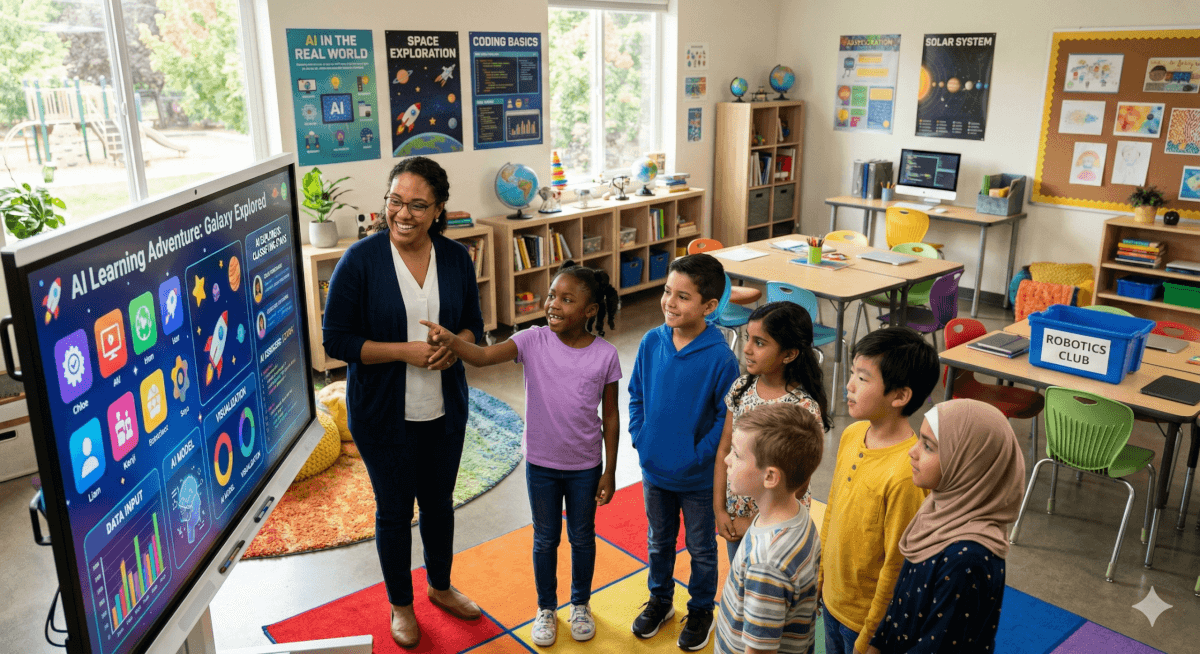
A kindergartner asks Alexa a question. A fifth grader generates an AI illustration. A high school student fact-checks ChatGPT. AI is already in your classroom. The real question is: Are we teaching students how to understand it and create with it? Teaching AI in K-12 doesn’t have to be difficult.
AI Literacy K–12 at Your School?
If you’re wondering how to start teaching AI in K–12 without rewriting your curriculum, you’re not alone. The good news? AI standards for teachers already exist from ISTE, AI4K12, CSTA, and NGSS. They’ve done the heavy lifting. Students can learn to create with AI technology just like they learn coding, 3D printing, website building, or robotics.
Why a Structured AI Curriculum Matters
But here’s the challenge: giving students access to AI tools isn’t the same as teaching AI. Without a structured curriculum, students teach themselves — and the results aren’t great.
Research from Stanford’s Institute for Human-Centered AI suggests that 70–80% of students use AI to shortcut learning rather than deepen it. Professor Mehran Sahami recommends a clear progression: introduce what AI is, teach about hallucinations and bias, show how to verify outputs, then move into advanced techniques like prompting [1]. That progression is exactly what the education standards provide.
This matters for more than just technology class. Teaching AI literacy builds workforce readiness, critical thinking, digital citizenship, and ethical reasoning — skills that cut across every subject area. And because these skills are mapped to standards for core content areas, you’re not experimenting. You’re aligning to frameworks that principals and curriculum directors already recognize
Let’s break down what an AI curriculum in K–12 actually looks like — by grade band.
Where should we send this resource?
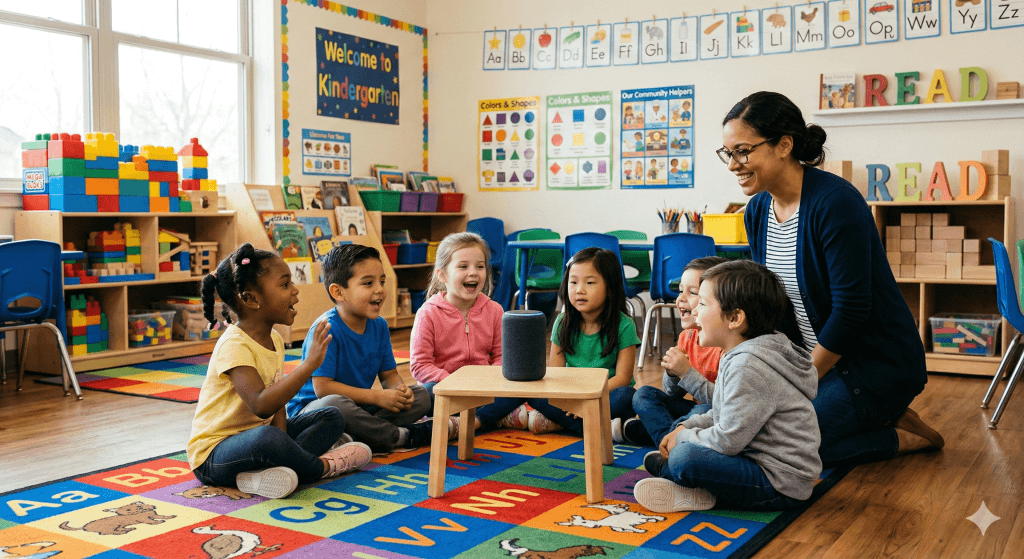
Young kindergarten students sitting on a classroom carpet talking to a voice assistant while their teacher guides the activity.
AI Lessons for Elementary Students (Grades K–2): Building Awareness
Picture your students gathered on the carpet, asking an AI assistant why the sky is blue — then discussing whether the answer was right. At this level, teaching AI in the classroom focuses on awareness, not algorithms.
Students learn to:
- Model simple processes and provide examples to influence AI outputs (CSTA 1A-AP-08)
- Recognize AI systems in voice assistants and apps (AI4K12 Big Idea 1)
- Use AI tools with teacher guidance (ISTE 1.1a)
- Ask simple questions to AI systems (NGSS 3–5-ETS1-3)
- Sort objects by similarity — early pattern recognition (AI4K12 Big Idea 3)
No coding is needed at this stage — just curiosity. The goal is to help students realize that computers and AI tools can “learn” from examples. That single idea changes everything later.
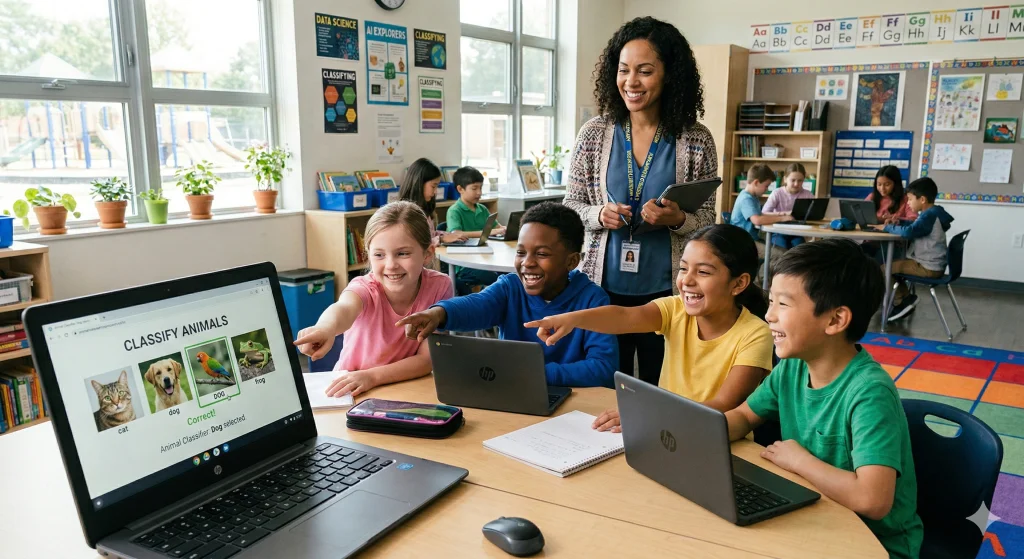
AI Activities for Grades 3–5: Training and Testing AI
Now students move from awareness to interaction. This is where hands-on learning kicks in — and where many teachers are surprised by how engaged students become
AI curriculum in upper elementary includes:
- Compare AI answers to trusted sources to build evaluation skills (ISTE 1.3)
- Rephrase and improve prompts to get better responses – early prompt engineering (NGSS 3–5-ETS1-1)
- Collect and label data to train simple models like image classifiers (CSTA 1B-DA-06, AI4K12 Big Idea 3)
- Use AI for creative design, generating story illustrations or suggesting bridge designs (NGSS 3–5-ETS1-3)
Tools like Google’s Teachable Machine make model training visual and accessible — no coding required. Students see the direct connection: better data leads to better AI. That’s computational thinking in action, and it builds naturally on what they learned in earlier grades.
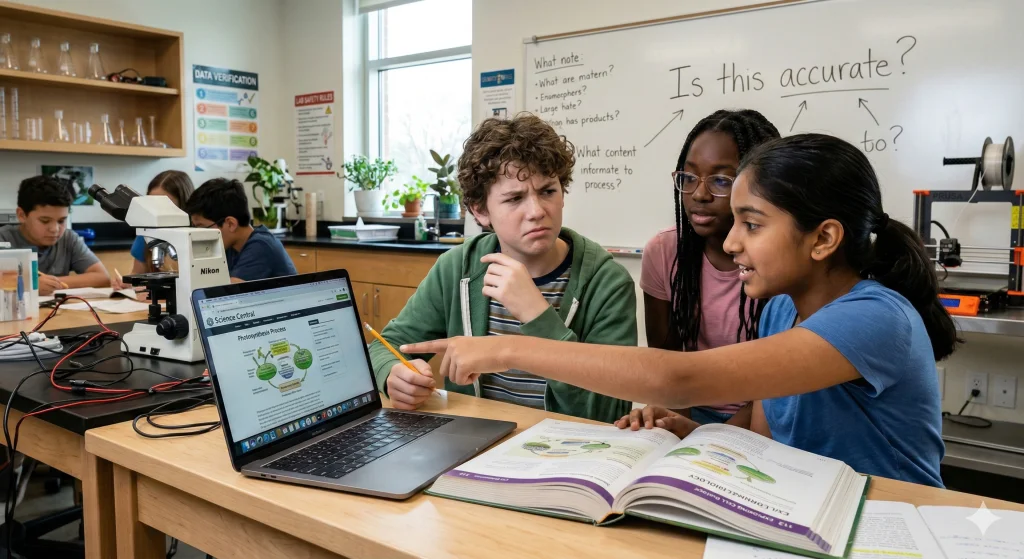
AI Lessons for Middle School: Teaching Students to Evaluate AI
Middle school (grades 6-8) is the critical window. Students are old enough to think critically about AI but young enough to form good habits before they start relying on it independently for schoolwork
Students learn to:
- Use AI as a brainstorming partner in STEM design challenges (NGSS MS-ETS1-1)
- Evaluate whether chatbot responses are correct (NGSS MS-ETS1-3)
- Identify biased training data and discuss fairness (AI4K12 Big Idea 5)
- Recognize AI limitations and understand that AI can make mistakes (ISTE 1.5)
- Design solutions using computational tools including AI (CSTA 2-AP-11)
- Compare AI model results across datasets to understand data quality and reliability (AIK12 Big Idea 3)
The goal at this level is healthy skepticism — not fear and not blind trust, but balanced evaluation. If students learn to question AI now, they won’t over-rely on it later.
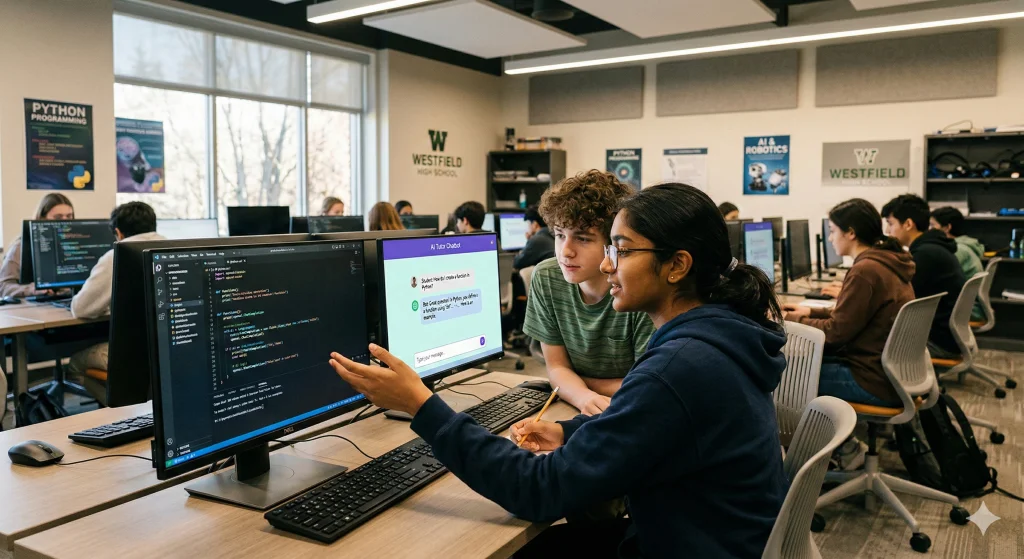
AI Curriculum for High School: Machine Learning, Prompt Engineering, and Agentic AI
High school (grades 9-12) AI instruction moves into creation and ethical uses of AI. Students aren’t just using AI — they’re building with it and thinking critically about its impact on the world.
Students can:
- Collaborate using AI tools on complex research and data analysis projects (ISTE 1.7)
- Use structured prompt templates to solve real-world problems (NGSS HS-ETS1-2)
- Train and refine machine learning models (AI4K12 Big Idea 3)
- Build AI programs and chatbots in Python (CSTA 3A-AP-16)
- Analyze AI ethics like facial recognition and hallucinations (AI4K12 Big Idea 5)
- Use machine learning to design solutions to complex real-world problems (NGSS HS-ETS1-2)
- Design AI-supported solutions and multi-step AI workflows (NGSS HS-ETS1-4)
This isn’t theoretical, it is hands-on. A student who builds a simple Python classifier or chatbot walks away with a portfolio piece and a taste of real AI development. That’s career-aligned learning that prepares them for STEM careers.
According to the Institute for Human-Centered AI, Stanford University, Stanford, CA, “The AI Index 2025 Annual Report,” “CS teachers in the U.S. want to teach AI but do not feel equipped to do so. Despite the 81% of CS teachers who agree that using AI and learning about AI should be included in a foundational CS learning experience, fewer than half of high school CS teachers feel equipped to teach AI.” [2]
Where should we send this resource?
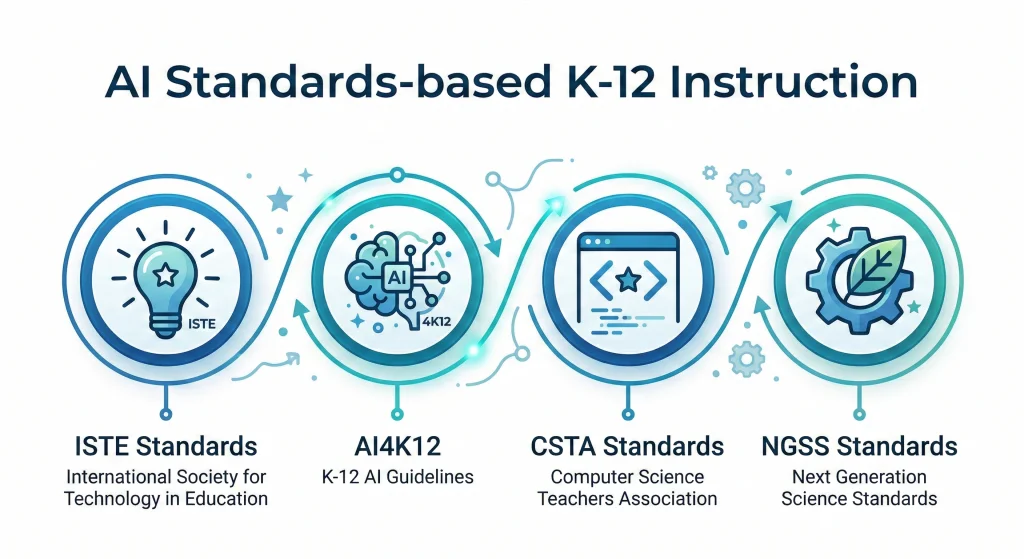
How AI Standards Align with ISTE, AI4K12, CSTA, and NGSS
If you need administrative buy-in, this section is for you. AI education aligns directly with standards your district already references:
- ISTE Digital Learner Standards (Empowered Learner, Computational Thinker, Innovative Designer, Global Collaborator)
- AI4K12 Big Ideas (Perception, Representation & Reasoning, Learning, Natural Interaction, Societal Impact)
- CSTA Data and Programming Standards
- NGSS Engineering Design Practices
Teaching AI in K–12 is not “extra.” It’s standards-based instruction. When you present it this way to your principal or curriculum director, the conversation shifts from “Should we do this?” to “How do we get started?”
Free Download: K–12 AI Standards Progression Map
Want a clear roadmap for teaching AI in K–12?
Where should we send this resource?
It is aligned to ISTE, AI4K12, CSTA, and NGSS standards. This table or spreadsheet includes a list of AI standards in K-12 with example activities for every standard.
Use it to:
- B — Build a district-wide AI literacy plan
- I — Identify gaps in your current curriculum.
- P — Plan vertically aligned AI instruction
- P — Present a standards-based proposal to your administration
These elements help your school turn AI funding into real classroom results.
You Don’t Have to Be an AI Expert to Teach AI
Most teachers hesitate because they think: “I don’t know enough.” Here’s the reality: You are not expected to know everything about machine learning. You are expected to guide inquiry and support your classroom instruction program. The standards scaffold the learning progression so you don’t have to invent it yourself.
Start with one AI activity, in one grade band, in one lesson this month. Then try another next month. Momentum beats perfection.
AI shouldn’t replace teachers. But it can amplify great teaching. And if you’re reading this, you’re already leading the way.
Teachers participating in an AI professional development session
Ready to Bring AI into Your Classroom?
EdforTech can help you give teachers the tools and training to bring STEM and AI to life in the classroom. We provide AI Professional Development for K-12 teachers – from those who are just beginning, to those who are well on the journey to implementing AI.
Whether you need a single workshop or a district-wide implementation plan, we can help you get started. Contact us to learn more about our AI and STEM professional development programs.
Reach out today — The sooner we start working together, the more likely we will finish a successful AI project at your school.
Where should we send this resource?
FAQs: Common Questions About AI in K-12 Education
Resources: Trusted Links for Teaching AI in K-12
You don’t have to build your AI curriculum from scratch. Some of these organizations offer free, classroom-ready resources:
- MIT RAISE (Responsible AI for Social Empowerment and Education) — Offers free K–12 AI curricula, lesson plans, and the popular “Day of AI” program that schools can run as a one-day event.
- ISTE AI Innovator Studio – free projects using AI
- Code.org Curriculum for the AI era – the leading global nonprofit ensuring every student has the opportunity to understand how AI works, how to reason with it, and how to create with it — not just use it.
- AI4K12.org — The source for the Five Big Ideas framework, with grade-band guidelines and teaching resources developed by AAAI and CSTA
- AI + Ethics Curriculum (MIT Media Lab)
- Stanford HAI – AI + Education Research and Brookings Institute — Publishes research on AI in education and practical guidance for educators navigating AI integration.
- U.S Dept of Education 2023 report on AI and the Future of Teaching and Learning
- National Science Foundation – AI Education Resources
- World Economic Forum – Future of Jobs Report
(This article was generated as a collaborative effort between the human author, Linda Nichols-Plowman, CEO of EDforTech and the AI assistants, Chat GPT 5 and Claude Sonet).